


Introduction
Patriarchy isn’t a relic of the past. It’s something that quietly organizes much of our present. For centuries, women have been expected to live a step beneath the men in the workplace or the home. More than that, in how they dream, speak, and even imagine freedom. But the rise of technology is changing the norm. The power that used to sit neatly in institutions like governments, corporations, and media began to leak online.
The internet opens new ways than to share photos or cat videos. It opened a space where anyone could speak, challenge, and connect. Women who had been dismissed in traditional media could now write blogs, start YouTube channels, or mobilize through hashtags.
Feminism discovered a new channel and in various aspects a new style. The digital realm intertwined the physical with the political. The critics of the patriarchy who were perhaps restricted to universities or protests are now heard worldwide. It is not a straightforward tale nor a completely victorious one, but this is exactly what makes it so fascinating to narrate.
From the Streets to the Screens: The Waves of Feminism
Feminism is like a tide that’s receding, returning, reshaping itself with each generation. Scholars often describe it in “waves,” and while the metaphor can feel near to a fault, it does capture something about the evolution of collective struggle.
The First Wave in the late 19th and early 20th centuries was about recognition. It was women demanding a voice in the political arena. Their calls include voting rights, property rights, and a say in the laws that governed their lives.
The Second Wave (roughly the 1960s to 1980s) broadened the scope of the movement. Women began questioning the domestic and cultural boundaries placed around them. This was the era of the famous declaration that “the personal is political.” Issues of reproductive freedom, workplace equality, and sexuality took the center stage.
The Third Wave, rising through the 1990s and early 2000s, pushed back against the idea of a single, monolithic “woman’s experience.” It brought intersectionality into mainstream feminist thought. It’s acknowledging that race, class, nationality, and sexuality all shape how inequality operates.
It’s from this third wave that digital feminism was born. Feminists began looking at technology as a political area that could either reproduce patriarchy or disrupt it. The internet became both a mirror and a battlefield
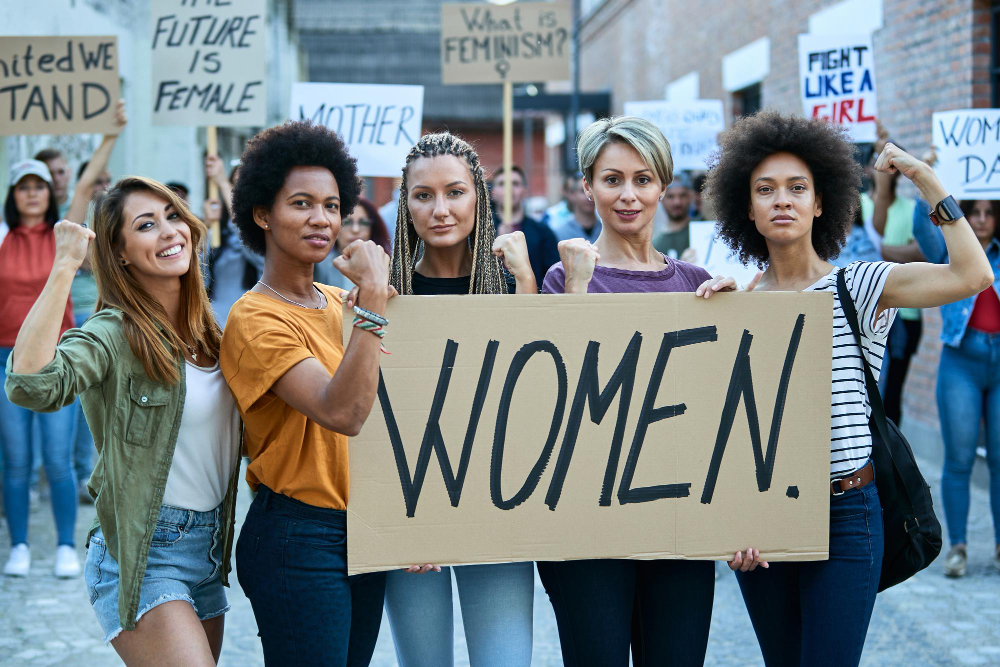
Feminist Movements in Digital Spaces
The term cyberfeminism was first used in 1994 by Sadie Plant. It’s a combination of feminism and technology. It surfaced when women started to investigate the ways online spaces could be used to critique, undermine, and even transform the systems of patriarchy.
Middle-class women in Western society with access to technology dominated the space and has since grown into a global movement. It delves into the gender and power dynamics in the virtual spaces while applying the same methods of prevailing, informing, and reconstructing through these spaces.
Feminist online platforms like blogs, podcasts, and digital magazines have turned out to be the modern consciousness-raising circles. Posting on Twitter, sharing on Instagram, and writing on Substack resemble the zine of our era. What was once a neutral and often male-coded web is now being rewritten by women as a living space of resistance.
How Online Spaces Empower Women
The streets once echoed with chants. Hashtags rally people, too.
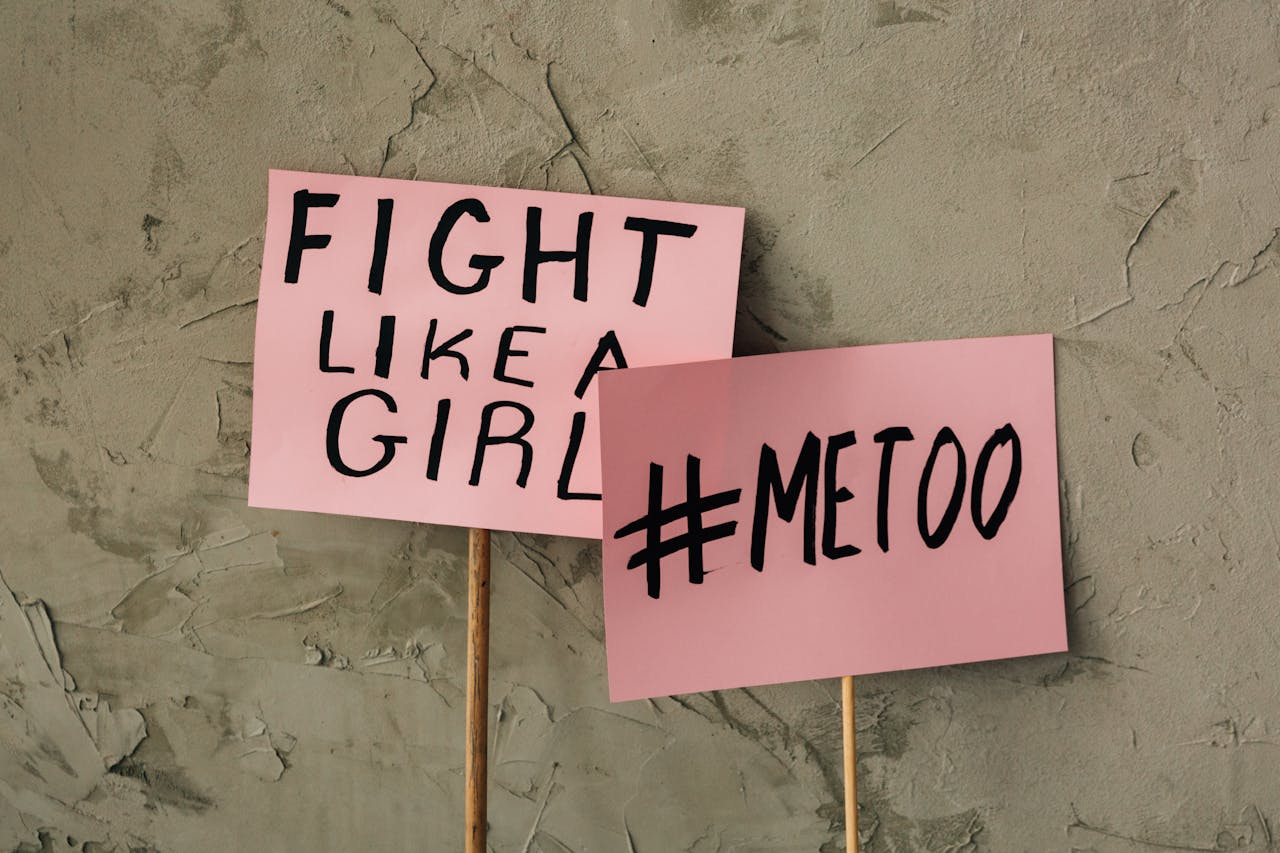
#MeToo, for instance, started quietly. It’s just a phrase meant to connect survivors. But it became a global reckoning against those forced institutions from Hollywood to the UN to confront their complicity. In Iran, the hashtag #MahsaAmini ignited global outrage after the death of a young woman in police custody, becoming a symbol of women’s fight for bodily autonomy and freedom. India saw the hashtag #LahuKaLagaan, meaning 'the tax on blood', makes the government come face-to-face with the ridiculousness of taxing products related to menstruation. The Philippines witnessed the birth of #BabaeAko ('I am a woman'). It’s a strong online movement that brought back women's voices into the public debate.
These activities are indicative of the power of digital activism to transform local issues into global ones. A single tweet may influence the thinking of the lawmakers who are situated on the opposite side of the earth; one brief video on TikTok can trigger a demonstration in the physical world. In Brazil, over the internet, feminist organizations such as Blogueiras Feministas, Think Olga, and AzMina have dealt with race, reproductive rights, and sexuality, which are still largely ignored by the mainstream media, through their online platforms.
Democratization of Feminist Movements
What makes digital feminism different is its openness. You don’t need a publishing deal or an academic degree to join. The internet decentralizes authority. It turns users into participants, learners, and teachers. Feminist activist Faith Wilding once said that new media allow women to “create new languages, platforms, and identities to reprogram the feminine condition.” That might sound lofty, but she’s right.
Traditional activism, such as marches, strikes, and sit-ins, still has its place in the world today. However, the approach to activism on the Internet has no limits, and it can be done anytime and anywhere. The use of online petitions, digital storytelling, and social media campaigns gives different communities the opportunity to participate in collective action very fast and in a very inclusive way.
This way, cyberfeminism can be viewed as a democratized version of feminism. The very nature of it is chaotic, distributed, and available to everyone as in open-source. It doesn’t belong only to academia or elite circles. It’s accessible, local, and global all at once.
The Challenges of Digital Feminism
Digital Divide
But of course, the internet’s promise isn’t universal. You can’t join the conversation if you can’t get online. As of a few years ago, only about 30% of women globally had internet access. And in rural regions, that number fell to barely 12%. That means millions are excluded from the very movements intended to represent them. Without infrastructure, electricity, and affordable devices, the global feminism online is often far more urban, educated, and privileged than it appears.
If access remains unequal, digital feminism risks repeating old exclusions. That’s the kind of early feminist movements were once criticized for. Offline organizing, education, and policy reforms still matter if digital spaces are ever to become truly inclusive.
Online Misogyny
But the negative scenario comes as well. In fact, for most women, the internet is harsh and supportive at the same time. With every visibility that women try to assert, they get the backlash in the form of trolling, doxing, death threats, and sexualized harassment coming after them. According to the recent report by the UN Women, more than 50% of women over 18 years old experienced some form of technology-facilitated abuse in just Europe and Central Asia.
In the U.S., one in four (1 in 4) American women have experienced online abuse. The frequent types of online abuse experienced by them are cyberbullying (10%), sexual harassment (9%), and trolling (8%). Globally, 61% of those who face abuse also report loss of confidence or self-esteem. In the U.K., 48% of women who experienced domestic violence were also stalked or harassed online.
Digital misogyny extends patriarchal control into cyberspace. It silences through intimidation. It reminds women that the internet, like the world, wasn’t built with their safety in mind.
Still, every act of resistance, each refusal to disappear, matters. Digital feminism survives because women refuse to log off. They stay. They speak. They build communities that make the internet, however imperfectly, a little freer.
Conclusion
The internet hasn’t solved patriarchy. It simply relocated parts of the fight. By doing so, however, it has broadened the scope of feminism and the list of those who can influence it. The internet has provided a platform for women to express themselves, to communicate with each other no matter where they are in the world, and to introduce their version of activism to the new generation.
Digital feminism doesn't mean abandoning physical protests in favor of social media; instead, of just bringing the physical protests to digital platforms. It challenges one's perception about power, connectivity, and community, among others.
No, the network isn't a paradise. But it can be a tool to revolutionize the idea of justice if used in purpose and goodwill. The presence of feminism in the digital realm is already altering the fundamental programming of our planet. And maybe, this is the most radical aspect of the situation.
