


Why Is 'Helping at Home' Still Seen as a Husband's Favour?
The Instagram Post That Made Me Pause
I recently came across a post on Instagram that made me pause for a moment. A picture of a husband assisting his wife in household chores, and all the comments below the picture were filled with appreciation. “What a lucky woman she must be!” one comment read, “He’s such a rare gem!” said another. Reading through all the comments, I couldn’t help but wonder; why is the sight of a helping husband still so novel? Why is there so much admiration towards men who wash the dishes, fold the laundry, or help make dinner at home? Ultimately, one can’t help but think of an unpleasant yet critical question: when did making your wife happy by doing your share of the housework become such a favor?
Why We Call It "Helping" Instead of "Sharing"
The more I think about it, the more one word stands out to me: helping. We use this word so loosely that we seldom pause to think about what it means. The man helps his wife wash the dishes, helps with the laundry, and helps take care of the children. Why "help"? The word implies that domestic labor primarily falls under ‘women’s duties’ and a man cannot be an equal contributor to said duties.
It is never said that the woman is "helping" the man when she cooks dinner for the family or cleans their common home.
That is the core of the matter. The point is not whether the husbands take part in the household duties but rather that household duties belong to the wife's sphere of activity by definition.

To this day, polls reveal that, irrespective of whether women are employed, they still carry out more housework than men. In addition to all the actual physical labor involved in managing a household, there is another less obvious task called the 'mental load' - this includes all the remembering, planning, organizing, and anticipation necessary to keep everything in order.
The food supplies should be replenished.
Meals should be planned.
School activities must be tracked.
Birthdays must be remembered.
Appointments must be made.
Chores must be completed before anyone else realizes their necessity.
It seems that whenever the man takes a few minutes to wash dishes after having dinner, everyone is eager to praise him for his helpfulness. Yet, taking into consideration the facts that both partners had their dinner, live under the same roof, and will benefit from having the kitchen immaculately clean, can it ever be considered helping? Is it really the terminology that counts, since we stop viewing things as ‘helping’ once we start calling them ‘sharing’?

Partnership Is Not a Scorecard
But what does it mean to share responsibilities? Sharing is not about calculating how many plates someone cleaned or whether they folded more clothes than their partner. Relationships and love cannot be reduced to spreadsheets with percentages.
The notion of a "50/50" marriage is prevalent nowadays. However, it is not always easy to balance everything equally. Some days, one partner will have more time, energy, or resources to contribute than the other. At times, they may carry a little extra weight; at others, they may need support in return. Healthy relationships are built on mutual trust and a willingness to show up for each other when needed. Which is why it feels unfair to describe a husband's contribution at home as a favour. If marriage is a partnership, then cooking a meal, folding laundry, or helping with the children is not one spouse going above and beyond for the other, it's simply both people taking care of the life they have built together.
I Grew Up Watching My Father Do His Share
When I think about all of this, I think of my father.
Growing up, I often saw him sharing household responsibilities with my mother. When he’d return from the office , he’d make coffee for himself, and Chai for her. If vegetables needed to be prepared for dinner, he would do the chopping. He would make chapatis, serve food to guests, dry clothes after they were washed, and iron. None of this was treated as something extraordinary in our home, it was simply part of being a family.
However, what caught my attention were the reactions from some of my relatives. Comments like "Bhabhiji ne dara ke rakha hai" (He must be intimidated by his wife) or "Yeh toh joru ke gulaam hain" (He is completely henpecked) were often thrown around jokingly. The assumption seemed to be that a man who contributes at home must somehow be less masculine.
But my father never cared about these comments. He did not consider himself a helpful husband because he had come to his wife’s rescue. He considered it to be the duty of both of them, and he would always tell me “Apne ghar ka kaam karne mein kaisi sharam beta?“ (Why should one feel shy doing household chores in his own house?)
In retrospect, I believe that my father was not doing his wife any favors; he was fulfilling his duties towards her in a marriage.
The Mindset We Inherited
This reaction, however, is not unique; even now, husbands who do their bit at home are frequently joked about or ridiculed. However, such behavior is not a mere coincidence because our attitudes can be traced back to how we grew up in our own homes.
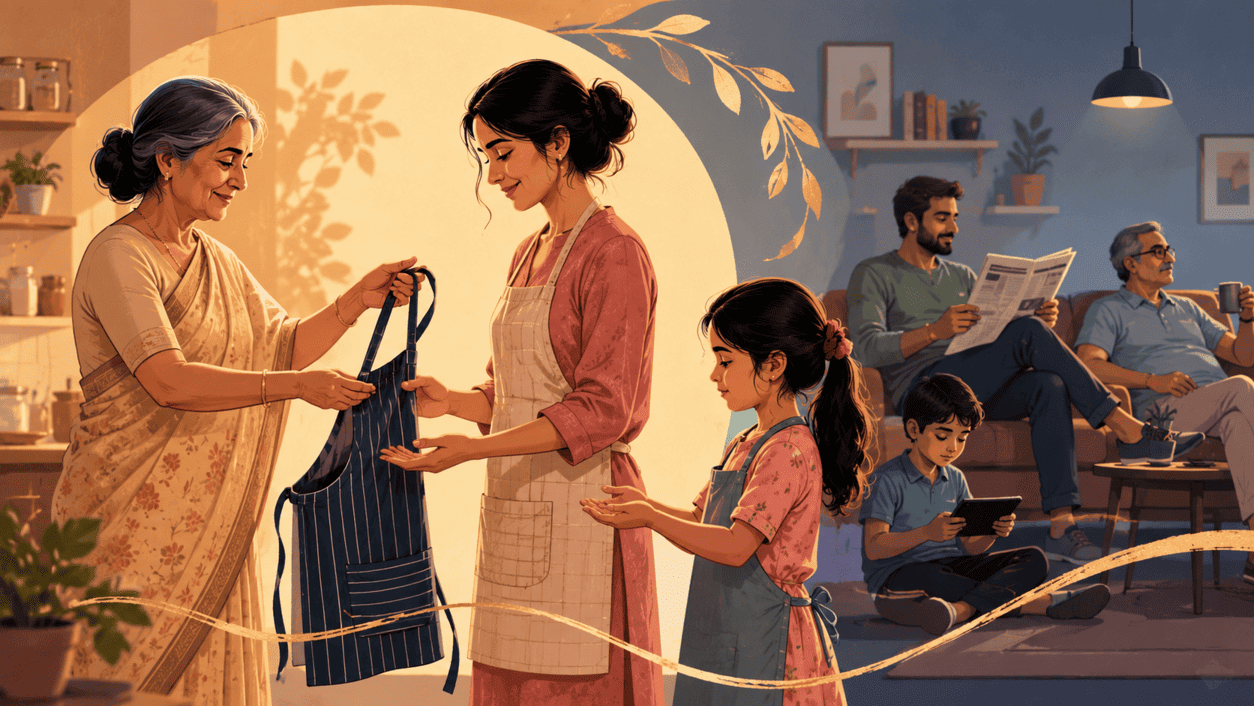
Growing up, girls learn all the chores related to running a house, but it is never expected of boys to know these things. Household chores become survival skills for one gender but optional skills for the other. This is how people start believing that managing the housework is something only women should be responsible for.
Maybe this is why husbands who take care of cooking, cleaning, or any other housework are often perceived as doing us a favor. We have grown up with the idea of housework being women's work, which makes any man taking an interest in such matters appear either extraordinary or unusual. But a house is property belonging to its inhabitants, not the females in it alone.
Beyond the Language of Help
As I grew older, I realized that this quality in my father that I loved most had nothing to do with how much he assisted with housework. No, it had everything to do with him not seeing it as “a favour”.
There were no household chores that my father considered to be my mother’s duties. He did the job because it needed doing, regardless of appreciation or reward, let alone consideration of any favors.
Maybe that is the sort of relationship dynamic that we should be encouraging: one where caring is not quantified, duties are not divided according to gender, and helping in the common household is routine, not exceptional.
This is because, ultimately, caring for the home and your family is not kindness but a joint effort and certainly not a favor.
