


Somewhere between boyhood and adulthood, most men receive a lesson nobody explicitly teaches but everyone seems to understand. Your feelings are yours to manage, and the managing should happen out of sight. Keep it together. Walk it off. Don't make it everybody's problem.
Most men do exactly that. For years. Quietly.
Here's what that quiet costs. Men in the US die by suicide at nearly four times the rate of women¹. In the UK, suicide remains the leading cause of death for men under fifty². Men are far less likely to seek mental health support than women, not because they're struggling less but because they've spent their lives being told struggling is something to hide, not address.
None of this is new. What's newer is the growing willingness to look at the culture producing these patterns and ask whether we're going to do anything different.
How Masculinity Teaches Boys to Shut Down

It doesn't start with one big moment. Studies on early childhood communication show that parents, on average, use more emotional language with daughters than with sons. Boys get less verbal comfort when they're scared, and the raised eyebrow when they cry over something adults have decided isn't cry-worthy. Children read fast what's actually rewarded, not what's said.
By secondary school, peers take over enforcement. There's a specific social punishment for boys who express distress openly, and it doesn't need to be cruel to work. A look. An uncomfortable silence. Being the guy who "can't handle it." Boys learn the safest performance of masculinity is one that doesn't show much of anything.
Promundo's Man Box study, surveying young men across the US, UK, and Mexico, found that men who most rigidly followed traditional masculine norms had worse mental health outcomes, higher depression rates, and heavier reliance on alcohol than men who held those norms loosely³. Someone told their whole life to suppress everything eventually has nowhere to put what they're feeling, and the surprise is that we keep acting surprised by the consequences.
What Happens Physically When Emotion Has Nowhere to Go
Suppression isn't neutral. The body responds to chronic emotional suppression in measurable, physical ways.
Research reviewing decades of prospective studies links suppressed anger and hostility to significantly higher rates of coronary heart disease, with the effect showing up more strongly in men than in women⁴, alongside evidence connecting suppression to elevated cortisol and higher cardiovascular risk more broadly. "Man up" isn't just bad psychological advice. It's bad for men's bodies.
When emotion can't go inward, it tends to come out sideways. The American Psychological Association's guidelines on working with men note that traditional masculine socialization is linked to higher substance use and a reluctance to seek help⁵, and men are more likely to report back pain, chronic fatigue, or irritability at a doctor's office, because that's often how depression presents in men, not as sadness but as a physical complaint. A lot of genuinely depressed men never get that named. They just get written off as difficult or burnt out.
Race, Culture, and Why the Burden Isn't the Same for Every Man
There's a tendency to treat "men" as a monolith, but emotional suppression isn't identical across race and culture.
For many Black men, masculine conditioning layers on top of racial survival strategy, making it harder to be perceived, or to see themselves, as people who need support. Among Latino men, rigid interpretations of machismo frame emotional vulnerability as incompatible with being a man. For Asian men, cultural stereotypes that flatten them emotionally make it harder to be taken seriously. Different entry points, same outcome.
Why "Just Talk to Someone" Is Not as Simple as It Sounds
Researchers studying masculinity and help-seeking in Queensland, Australia found that for many men, seeking mental health support didn't just feel uncomfortable, it conflicted with their sense of identity⁶. Asking for help registered internally as a kind of self-betrayal.
It's not that men don't know help exists. It's that reaching for it can feel like confirming something they've spent their lives trying to disprove. So they don't. They keep working. They keep drinking. They grow increasingly unreachable to people who can see something is wrong but don't know how to get through, partly because the man himself doesn't have language for what's happening.
Telling someone to "just go to therapy" without acknowledging what that ask costs them isn't helpful. It's outsourcing the discomfort back to them.
What's Actually Helped, Where It's Been Tried
There's a detail worth knowing about depression screening research out of Australia and Canada over the last decade. Researchers found that standard depression checklists, built largely around how the condition presents in women, miss a meaningful share of depressed men⁷.
Persistent sadness. Crying. Withdrawing from people. But a deeply depressed man is more likely to show up at his GP complaining about his back, or saying he's exhausted, or that he's been getting into arguments he can't explain. He doesn't tick the right boxes, gets sent for a scan, and the actual problem gets another six months to get worse. Male-specific screening tools built to catch anger, substance use, and somatic symptoms have started catching men who'd been coming in for years, treated repeatedly for symptoms nobody had connected to anything.
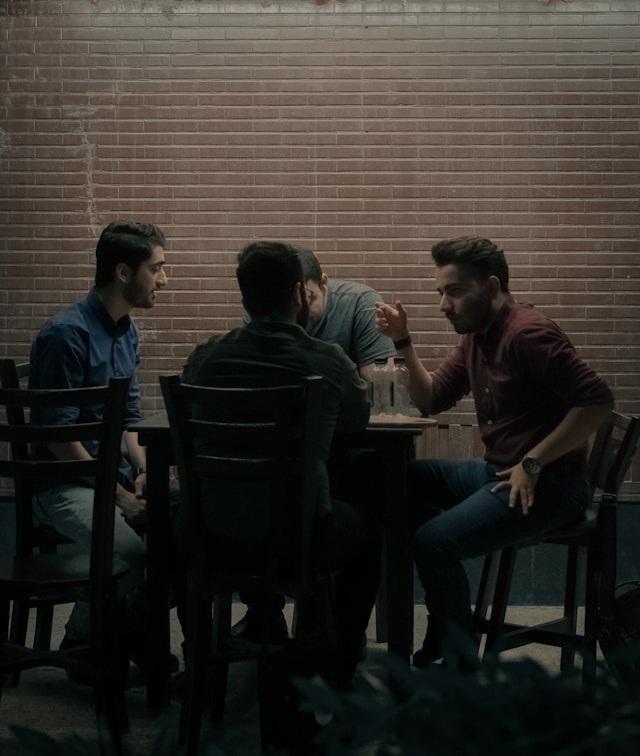
Ask researchers what actually gets men into treatment, and the conversation lands in the same place. Not campaigns alone, but peer-based programs where one specific man who another man knows personally shares, without drama, that he got help and it did something⁸. The leaflet in the waiting room doesn't move the needle as reliably as the bloke from work who mentions it.
The Language Problem
There's an assumption that if resources are there, men will use them. But "mental health support" belongs to a mode of asking for help most men were actively discouraged from practising, sometimes for their entire lives. It's not that the words are unfamiliar. They carry a social history.
Some intervention programmes have had more success by attaching the same work to goals men were already bought into. Research on masculinity and help-seeking found that coaching, framed around performance and identity rather than therapy, was significantly more appealing to men than traditional face-to-face mental health support⁹. The content isn't different. The context is, and that matters to whether men stay in the room long enough for it to land.
There's a pattern in the research that doesn't get discussed much. Men who tried being honest about struggling and had that honesty backfire, used against them later or treated as evidence they're not coping, tend not to try again. For a lot of men, past experience has already answered whether honesty feels worth attempting.
The Real Cost of All This Silence
Suicide remains the leading cause of death for men under fifty in England and Wales, year after year². Men in the US die by suicide at close to four times the rate of women¹. The figures have stayed consistent long enough to feel like background noise, which is its own kind of problem.
A kid grows up knowing something is off with her dad but never able to name it, because he never could either. Someone realises years into a marriage that they've been trying to reach a person who doesn't have access to what's being asked of him. Men who manage their internal lives privately get extremely good at it, good enough that people around them can't tell things are bad until they're very bad.
There's a version of strength sold to men that is really just prolonged concealment. It carries enough cultural prestige that it can take decades to recognise it as a coping mechanism rather than a character trait.
The research on what suppression costs men has been accumulating for years: heart disease, shortened life expectancy, addiction, depression that never gets named as depression. Whether any of that changes depends less on what we say about men's mental health and more on what we actually make permissible.
