


Homonationalism may sound like an academic term, but it can shape real government policies, political agendas, and public narratives. Gender studies scholar Jasbir Puar authored the word in 2007, in her book Terrorist Assemblages: Homonationalism in Queer Times. She noticed an occurrence she saw over and over. Rights for LGBTQ+ people are also strongly advocated by some nations as a means to appear modern, progressive, and tolerant in comparison to other countries and cultures, and not necessarily because of their actual stance on those rights.
With homonationalism, queer rights are a badge a nation wears, a tag to make wars, closed borders and racial hierarchies appear legitimate. Badges "people" receive little or no benefit from it.
In the world of advocacy, media, and brand strategy, this word is a must-know. It helps me to understand why a nation could have marriage equality laws in place and still be locking up queer refugees at its border. It is a complete explanation of why a company can have a rainbow flag in June and hide behind the votes of other lawmakers who are against LGBTQ+ rights the rest of the year. After you see the arrangement, you begin to see it all over your place.
The following are five of the ways that homonationalism affects LGBTQ+ rights in the present.
1. How Homonationalism Turns Gay Rights Into Proof of a Civilised Nation
The word first came into use by Puar to describe the war on terror. Following the September 11 attacks, the United States presented itself as a ******** liberated country that is engaged in a battle against ******** repressed enemies. Gay rights at home were used to excuse the invasions of Iraq, Afghanistan, and other countries. This framing has been referred to by writers later as sexual exceptionalism.
A country's treatment of its LGBTQ+ citizens was used to gauge its legitimate authority to invade, judge, or govern other countries. This also prevails in foreign policy today. Attitudes towards LGBTQ+ people can become a sword against another country. It makes little noticeable effort for its very own LGBTQ+ citizens.
2. It Fuels Pinkwashing
Pinkwashing is a close cousin of homonationalism. Governments and companies use it to highlight gay friendly policies while they hide harm elsewhere. Writer Ali Abunimah named the practice in 2010.
Corporate Pinkwashing
Businesses do an abbreviated version of this trick. In fact, Mercedes-Benz has previously changed its logo colors for Pride Month, just in countries where it is legal to be gay. The transfer was seen as being without any substance and just a marketing move. There are lots of brands that show their pride in June and donate to politicians who are against gay protections the rest of the year. There are numerous brands that celebrate pride during the month of June, but who vote against gay protections during the rest of the year.
State Pinkwashing
Governments use the same trick on a bigger stage. Israel's tourism campaigns often present Tel Aviv as a gay haven. Critics call this pinkwashing, because it draws attention away from the occupation of Palestinian territory. Supporters of Israel reject that framing and point to real legal protections for LGBTQ+ citizens. The debate is contested and deeply political, but it shows how a nation's LGBTQ+ record can double as public relations in a conflict that has nothing to do with *********.
3. It Shuts Out LGBTQ+ Refugees
It excludes LGBTQ+ Refugees
Homonationalism can also affect how nations treat LGBTQ+ refugees. A country may present itself as gay-friendly while maintaining asylum systems that make it difficult for queer people to receive protection. In the UK, the Netherlands and other European countries, the asylum seekers must establish their ********* to be acknowledged as a refugee. One of the challenges is the invasive questions they ask and the evidence they are demanding which is often impossible to obtain.
This system is based on outdated and prejudiced notions, according to researchers. It sees non-Western countries as in by nature repressive, and distrusts any claims from those countries, yet it refuses to protect the very people that are escaping from repression
Studies of asylum systems in Serbia, the Netherlands, and the UK found queer applicants held in detention, asked about intimate aspects of their lives and refused admittance based on the lack of presentation of being gay enough as perceived by the asylum officials. It is possible to advertise a country as a safe place for LGBT people and have an asylum system that excludes most of them.
4. It Divides the LGBTQ+ Community by Race and Class
Homonationalism does not necessarily benefit all LGBTQ+ people equally. Puar argues that it can elevate a narrow image of the acceptable queer citizen: white, wealthy, and able to fit dominant ideas of respectability. Puar claims its focuses a small figure, white, wealthy, and able to pass as a normal citizen. This is where intersectional feminism becomes important, because LGBTQ+ experiences are also shaped by race, class, disability, and immigration status. That image does not apply to LGBTQ+ people who are Black, Indigenous, disabled, trans or poor and they do not enjoy the same protection or adoration.
The Rise of The Pink Dollar is a book that should be on every bookshelf.
Some of this change can be accounted for by the actions of what Tim McCaskell calls the pink dollar: the purchasing power that started to inspire businesses to seek the attention of gay consumers from the 1990s forward, says the scholar. It didn't take long for visibility and marketing deals to come along. Not all queer people were protected equally, and those who were not—poor, Black, Indigenous, trans and immigrant—were not fortunate enough to be protected at the same rate. The outcome is a bi-polarized LGBTQ+ movement. One tier receives brand deals, wedding announcements and political praise. The other tier continues to experience poverty, policing and neglect, frequently from the very same institutions that purport to defend the rights of the LGBTQ+ community.
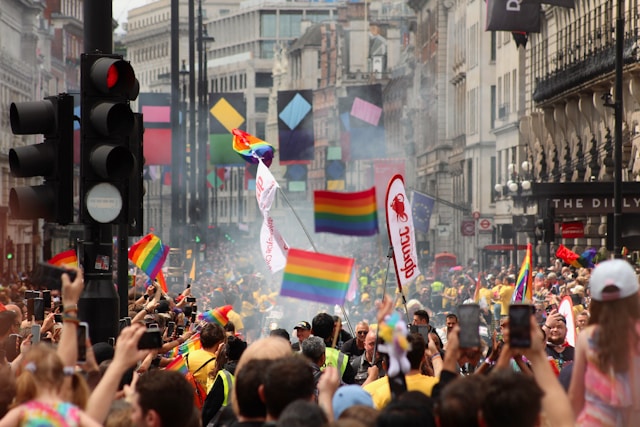
Image Link: Unsplash
Alt text: A diverse LGBTQ+ community or grassroots march
5. It Feeds Anti-Muslim and Anti-Migrant Politics
Homonationalism can also influence immigration and political debates. In some European countries, politicians have used LGBTQ+ rights to portray migrants, particularly those from Muslim-majority countries, as threats to sexual freedom. Homonationalism gives anti-immigrant politics a new script. Some European politicians now use gay rights to argue against immigration, especially from Muslim-majority countries. They claim migrants threaten a country's sexual freedoms, even when that same country has its own long history of homophobia.
Researchers studying the Netherlands and other EU states describe this as a homonationalist and Islamophobic bind. Queer Muslim asylum seekers face suspicion from both sides. Their countries of origin get painted as unsafe for queer people. Their new countries treat their faith as a threat to queer safety. Either way, they struggle to find real welcome, caught between two systems that each claim to protect them.
What Homonationalism Means for LGBTQ+ Rights
Homonationalism can reduce LGBTQ+ people to political symbols—a sign of national progress, a foreign-policy tool, or a face for a Pride Month campaign. Understanding why equality matters also means looking beyond symbolic representation and asking who actually benefits from policies and public campaigns.
If you are unfamiliar with the term ‘homonationalism' then you should become familiar with it first. The next step is to be practiced as a habit: Every time a country or a brand says it is "standing up for the rights of LGBTQ+ people," ask "for who? and who is not included?
