


For many women, the biggest barrier to economic independence is not a lack of ambition or ability. It is the absence of opportunity.
For generations, driving an auto-rickshaw has provided a dependable livelihood for thousands of families across India. It offers something every household values: a regular income, financial security and the dignity of earning a living. Yet this profession has remained overwhelmingly inaccessible to women. Social expectations, concerns about safety, limited mobility and deeply rooted stereotypes have ensured that women are more often seen as passengers than as drivers.
That is why the women driving pink electric autos in Amritsar represent something much larger than a new mode of transport. They represent a future where the transition to clean mobility is also a transition towards greater economic inclusion.
Amritsar, Punjab's second-largest city, is expanding rapidly. Alongside its growth have come familiar urban challenges: rising traffic congestion, deteriorating air quality, and increasing carbon emissions. Cleaner transport has become a necessity, not a choice. Yet the success of the clean mobility transition should not be measured only by the number of electric vehicles on the road. It should also be measured by who benefits from that transition.
The RAAHI (Rejuvenation of Auto-Rickshaws in Amritsar through Holistic Intervention) scheme, launched in 2019 under the CITIIS (City Investments to Innovate, Integrate and Sustain) program, set out to replace over 12,000 ageing diesel auto-rickshaws with electric vehicles, reducing both air and noise pollution in the city. As part of this initiative, the Pink Auto program offered women a 90 per cent subsidy to own and operate electric autos—bringing together two goals that are too often discussed separately: environmental sustainability and women's economic empowerment.
When the initiative was announced, the challenge was not the availability of vehicles. It was ensuring that women knew about the opportunity and felt confident enough to seize it.
My colleague, Harwinder Singh, and I began travelling across Amritsar, visiting neighborhoods, knocking on doors and sitting with women and their families. We met domestic workers, women who stitched clothes from home, cycle-rickshaw drivers, daily wage earners and homemakers who had always wanted to contribute financially but had never imagined commercial driving as a possibility.
These were not conversations about electric vehicles alone. They were conversations about livelihoods, dignity and independence. We listened to fears about safety, family acceptance and social judgement. We also heard something else—a quiet determination to build a better future if only the opportunity existed.
As more women expressed interest, it became clear that they needed a platform to come together. Clean Air Punjab organized a city-wide convening where nearly 200 women gathered to learn about the initiative, ask questions, share concerns, and meet others considering the same journey. For many, it was the first time they realized they were not alone.
The momentum extended beyond the convening. Women leaders from the Clean Air Punjab network, together with its member organizations, wrote to the Ministry of Housing and Urban Affairs (MoHUA), urging it to expedite the implementation of the scheme. Their appeal reflected a shared belief that clean mobility should also create dignified livelihood opportunities for women.
Once the scheme moved forward, another challenge emerged.
Most of the women had never driven a motor vehicle before. Receiving an electric auto was only the first step. Clean Air Punjab therefore organized professional driver and road safety training at a Maruti Driving School, supported the women through the licensing process and helped prepare them for a profession that had long seemed out of reach. Throughout this journey, the Municipal Corporation of Amritsar played a critical role in simplifying procedures and ensuring that the women could access the program with dignity and ease.
Among the participants was Sonia, a differently abled woman whose determination inspired everyone around her. She did not see the Pink Auto as a welfare measure. She saw it as an opportunity to earn a livelihood on her own terms. Her journey reminded all of us that when barriers are removed, talent and resilience find their way forward.
The challenges, however, did not disappear once the women began driving.
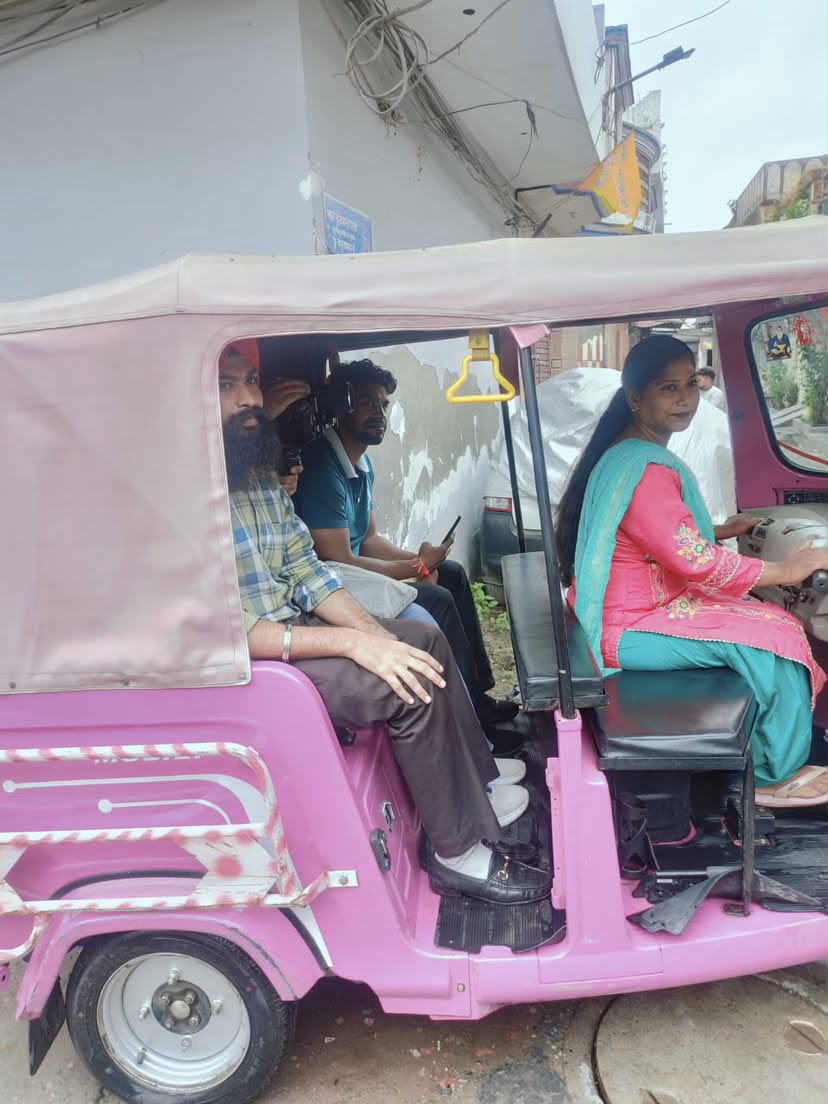
Many still speak of being stared at, questioned, or subjected to inappropriate remarks simply because they are women driving commercial vehicles. Some continue to face harassment and prejudice from male drivers who struggle to accept women in a profession long dominated by men. At the same time, they also speak of the encouragement they receive from passengers, who readily choose to travel with them and often appreciate seeing women behind the wheel. That acceptance has given many of them the confidence to continue despite the challenges.
Every day they navigate not only the city's traffic but also the invisible barriers that continue to shape women's experiences in public spaces.
Yet every morning, they start their engines and drive on.
Today, these women earn their own income. They help pay school fees, contribute to household expenses, save for the future, and participate more confidently in decisions within their families. The greatest transformation is not simply financial. It is the confidence that comes from knowing they have built something of their own.
For Asha Rani, driving a Pink Auto has brought financial stability she never imagined. On most days, she earns between 800 and 1,200 rupees, enough to support herself and contribute meaningfully to her family's income. "Life has definitely changed after this," she says with quiet pride.
For Sarabjit Kaur, the impact of the initiative is measured not in earnings alone, but in aspirations. Every day's work brings her a little closer to her dream of giving her daughters the opportunities she never had. "I hope I can save enough so that one day my daughter flies in an aeroplane," she says. It is a simple dream, yet it speaks volumes about what economic independence can unlock—not just better incomes, but bigger ambitions for the next generation.
This is what a just transition looks like.
Climate action is often measured in tons of emissions avoided or the number of electric vehicles deployed. Those indicators matter. But there is another measure that deserves equal attention: how many lives are transformed because the transition creates opportunity where none existed before.
The women driving pink electric autos through the streets of Amritsar are reducing emissions. But they are also doing something far more profound. They are expanding the idea of who belongs in public spaces, proving that clean mobility can create dignified livelihoods, and showing young girls that the road ahead is theirs to travel—not as passengers, but as drivers of their own futures.
India's clean mobility transition will be strongest when more women are behind the wheel.
