


In 1995, 189 countries signed the Beijing Declaration and pledged to remake the world for women and girls. Three decades on, the ledger is still open. What follows is not a story of failure, nor of triumph; it is an accounting of what policy has actually delivered, and what it has merely promised. The percentages of others have changed little over the past 40 years or so.
In the world as a whole, women hold only 30 per cent of managerial roles, and gender parity in such roles will not be reached for almost 100 years at the current rate of change. 351 million women and girls, or 35% of the world's female population, would continue to live in poverty if nothing were done from 2020 to 2030, despite the 10% goal. These are not lapses in awareness: the world is more aware than ever. They're budget problems, law enforcement issues, and a lack of political commitment.
What Caused the Needle to Move?
It has been almost invariably a policy decision that has driven real progress, rather than a cultural change. Maternal mortality has decreased by 40% since 2000, directly owing to continued investments in skilled birth attendance and access to reproductive health care. However, the gains are not persisting: by early 2025, over 60 percent of women-led HIV organizations had lost funding or offered fewer services, and the health equity achieved is as fragile as the funding.
The rate of intimate partner violence is 2.5 times lower in countries that have laws, institutions to support women, and national action plans on violence against women than it is in countries with weak measures. There was never any difference over whether there was a law or not. It was simply whether anybody paid to enforce it.
The Gap Nobody is Closing Fast Enough.
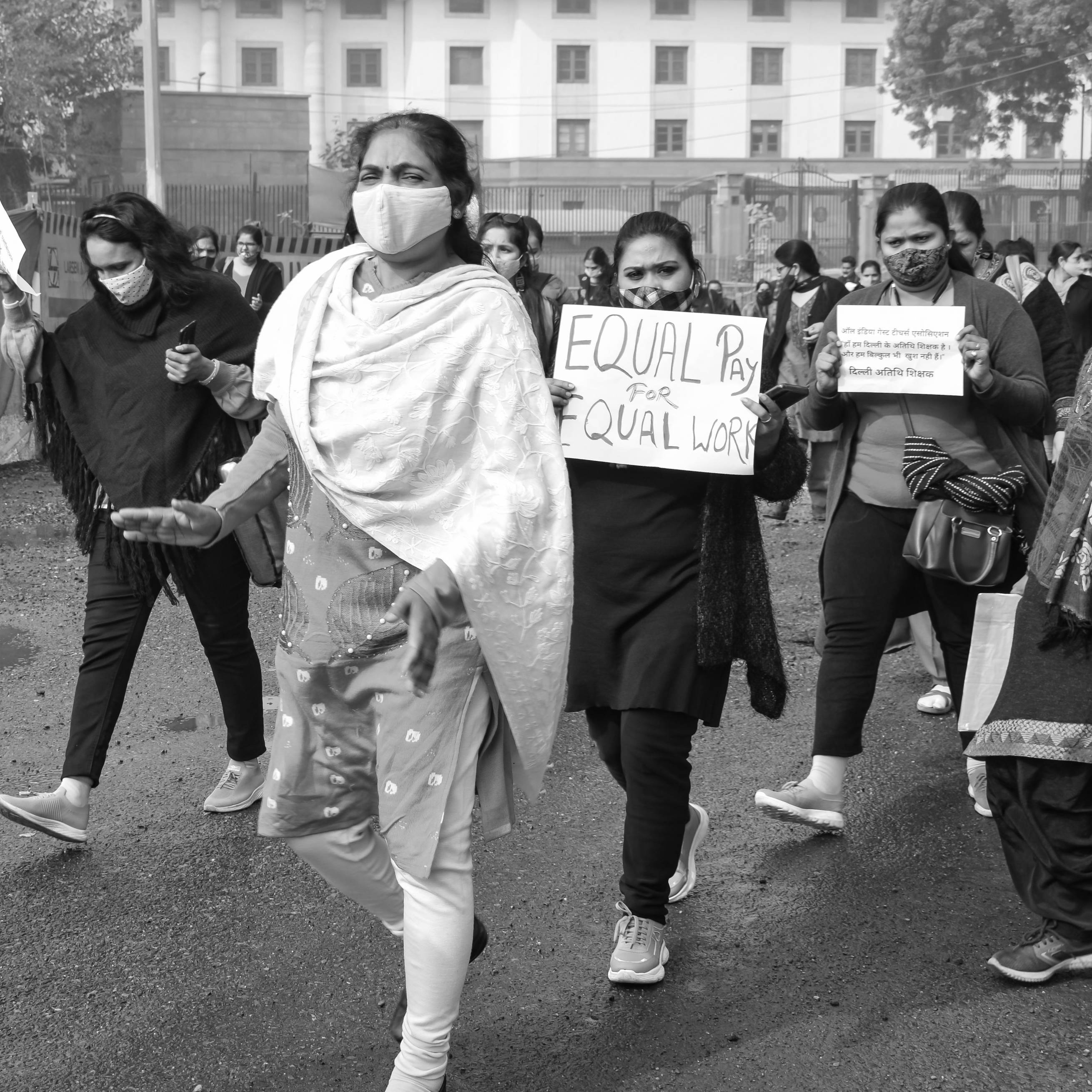
The situation is of two crises being superimposed on each other. First, care work: globally, 708 million women are outside of the labor force, and 6 hours and 25 minutes fewer women work in the paid market than men in a week, regardless of effort. Second, the digital transition employment for women is almost twice as exposed as for men to being replaced by Gen AI (27.6 percent vs. 70.1 percent), while 65 percent of the world's women are offline. Enabling the digital divide to close for good by 2050 would bring $1.5 trillion to the global economy by 2030 and help 343.5 million women and girls. The same can be said about parallel financial-inclusion policy, which saw the share of women in the labour force increase from 23.3 percent in 2017–18 to 41.7 percent in 2023–24, supported by an increase in over 28 crore women joining formal banking through Pradhan Mantri Jan Dhan Yojana in India. But despite being 131st on the list of 148 countries on the WEF Global Gender Gap Report 2025, India still has so much to achieve.
According to NITI Aayog, the country is an "aspirant" in the realm of gender equality, as the SDG is the only one in which the nation has not met the "achiever" standards. The figures for Kerala's literacy rate by gender, for instance, female 95.2 percent, and male 94.8 percent, are similar to those of other states, yet the figures for Bihar, 63.8 percent, show that a national policy not backed by regional implementation yields national statistics that mask as much as they display.
The Verdict
The rest of the story is that there's a difference between being in motion and being static. Social impact work has already worked its magic; it's now more than ever that the world knows some things need to be fixed. What is left is the second component of the title to make that awareness into policy that is funded, enforced, and implemented with sufficient uniformity to be effective in every area that it purportedly serves.
Systemic change is not a destination reached; it is a maintenance obligation that has to be re-funded and re-enforced every budget cycle, in every district, indefinitely. The distance between social impact and systemic change was never a question of whether the path exists. It is a question of whether governments keep walking the talk after the awareness campaign ends and the harder, less visible work of enforcement begins. The blueprint has been in existence since 1995. There was never a lack of knowledge of the need for transition to change. The issue of payment for it always existed.
